Account-based marketing (ABM) campaigns have a reputation problem.
Not because they don’t work - they do. Cognism’s own scaled ABM programme generated over $700K in pipeline in the first half of last year.
But too many teams launch ABM campaigns the same way: buy a platform, build a massive list, blast personalised-ish content, and hope for the best.
That’s not ABM. That’s expensive email marketing.
A real ABM campaign needs a plan. One that starts with the right account selection, aligns your teams around shared goals, and builds momentum over weeks. Not overnight.
This guide breaks down how to plan, build, and run an ABM campaign. We’re drawing on Cognism’s own enterprise ABM playbook, frameworks from our demand gen playbook, and advice from practitioners who’ve done this for real, too.
Looking for ABM campaign inspiration first? Check out our breakdown of 8 account-based marketing examples that worked.
Let’s get into it.
Pick the right type of ABM for your campaign
Before you create a single piece of content or pull a single contact, you need to answer one question:
What type of ABM are you running?
There are three tiers, and the one you pick shapes everything: your budget, your content, your team structure, and how long it’ll take to see results.
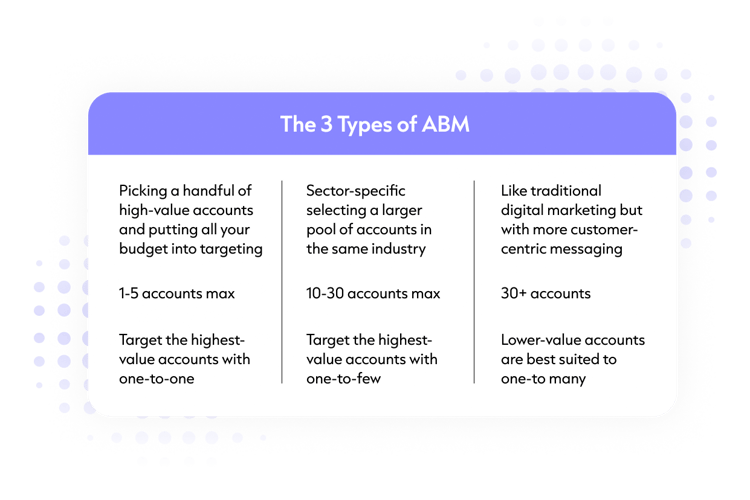
- 1:1 ABM - You pick a handful of high-value accounts (one to five) and go deep. Custom content, dedicated resources, personalised outreach to every stakeholder. This only makes sense for your highest-ACV opportunities.
- 1:few ABM - You cluster 10-30 similar accounts (same industry, same pain points) and target them with tailored messaging. Less personalised than 1:1, but far more efficient.
- 1:many ABM - You target a broader list (30+) with personalised-but-scalable campaigns. Think targeted LinkedIn ads, content hubs, and always-on nurture sequences aimed at your ICP.
Most teams don’t need to pick just one. The smart move is to layer them.
How we layer our ABM campaigns here at Cognism
When Cognism started targeting enterprise accounts in 2024, the team built three ABM plays that map to these tiers:
- The 1:many play targets a broad ICP-based segment with paid media (LinkedIn, Google) and content hubs. The goal is awareness and top-of-funnel pipeline.
- The 1:few play focuses on accounts showing hiring or intent signals. These get custom landing pages, content tailored to their use case, and SDR outbound.
- The 1:one play is reserved for open opportunities or strategic accounts with high ACV potential. Think account-specific ads, personalised gifts, private webinars, and direct sales air cover.
The key? Accounts aren’t locked into a tier. They move through the plays, showing more signals and engagement.
Internally, here at Cognism, we found the following when we focused on tiering accounts:
-
MQL to pipeline conversion: 47.9% (24% higher than the enterprise average).
- MQL to sales qualified opportunity conversion: 30.9% (48% higher than the enterprise average).
- Average opportunity ACV from ABM accounts is 46% higher than our enterprise all-bound average ACV.
Marnie Giuranna Zaccaria, ABM Manager at Fortinet, learned this the hard way:
"We had 25 strategically-chosen accounts we were working on in our ABM team. The sales team chose three accounts to focus more attention on, and the others we clustered together to do a 1:few approach. Of the three we bet on, only one was worth the time and resources we put into it."
That experience pushed Marnie to change course. All accounts started with a 1:few approach. Only when strong opportunities emerged did they upgrade to 1:1.
Not sure which tier to start with? Owen Steer, Senior Marketing Executive at Fifty Five and Five, has solid advice:
"Run a pilot programme. Probe the market with the one-to-many method. If you get good results, you can ramp up the pilot into one-to-few or one-to-one. You need to know the science behind your ABM operation to help you make informed decisions."
Align your sales and marketing teams
Here’s the uncomfortable truth about ABM:
It doesn’t matter how good your content is or how precise your targeting is if sales and marketing aren’t working from the same playbook.
On the face of it, ABM means asking your SDRs to work with fewer leads. What salesperson wants that? So getting genuine buy-in - not just a nod in a meeting - is essential.
Owen puts it bluntly:
"Getting buy-in from internal stakeholders, first and foremost, is absolutely essential. Of course, you need to secure a budget for your ABM campaign, but make sure you're setting realistic expectations. Be aware that it's a long-term campaign. ABM is not a short-term revenue grab."
And Marnie adds some real talk:
"In my experience, it takes about three years to get an ABM strategy up to speed because there are often a lot of stakeholders who are used to doing things one way. You're having to teach them something new. I highly recommend anyone starting out with ABM to invest time in educating your company."
Three years sounds like a long time. But you’ll start seeing results much sooner; the full strategy just takes time to mature.
What alignment actually looks like in practice
At Cognism, the ABM playbook programme is co-owned by demand generation, paid media, and a pool of sales reps and account executives. Not marketing-led, with sales informed. Genuinely co-owned.
The team runs quarterly creative days where content managers, demand gen, and paid teams plan campaigns together. Regular alignment meetings keep everyone on the same page as campaigns run.
Who needs to be in the room?
Your ABM team should include people from across the business. They’ll have different roles but shared goals:
- SDRs / sales reps - focused on outbound to target accounts.
- Marketing reps (MDRs) - following up on demand gen activity.
- Campaign marketers - building personalised campaigns end-to-end.
- Content producers - writers, designers, video producers.
- Sales and marketing ops - driving efficiency and keeping the data clean.
- Customer success - they know what makes accounts stick (and what makes them churn).
Owen’s advice here is worth repeating:
"Have regular meetings between sales, marketing, and CS to agree on a plan for each account and see how you can use the knowledge you already have in your team."
Set your ABM goals and metrics
If you don’t know what success looks like, you’ll never know if your campaign is working. Sounds obvious. But plenty of teams launch ABM campaigns with vague goals like “increase pipeline” or “improve engagement.”
Those aren’t goals. They’re wishes.
Joe Birkedale, Founder and CEO of Project36, puts it well:
“Before you start with ABM, you need to determine what you’re looking to get out of it. What’s your perfect end result? What are you hoping to achieve? Bear in mind that ABM is not a silver bullet. It normally takes a lot of time and effort before you see success."
Define your goals before you launch
Think about what you specifically want your ABM campaign to accomplish. Some examples:
- Generate pipeline from a specific set of enterprise accounts.
- Break into a new vertical or region.
- Accelerate deals that are already in motion.
- Increase deal size by engaging more stakeholders in the buying group.
Whatever it is, write it down. Share it with both sales and marketing. Make sure everyone agrees.
Pick the right metrics
Here’s where most teams go wrong. They default to the same metrics they use for everything else - MQLs, click-through rates, form fills. But those don’t tell you whether ABM is actually working.
At Cognism, the ABM team tracks metrics that actually reflect account-level progress:
- Account penetration - are you reaching multiple personas in the buying group? Not just one contact, but the full decision-making unit.
- Account engagement - who’s interacting with your ads, landing pages, and content? And how deeply?
- Pipeline progression - are target accounts moving through the funnel? At what rate?
We consider an account “engaged” at Cognism when its prioritisation score is above 55% to upgrade it from 1:many to 1:few.
.png)
The real insight is to go deeper than surface-level engagement. Don’t just track who clicked what, track who’s spending real time with your content. That’s the signal that matters.
Set these metrics before your campaign launches, align both teams on them, and share results openly as the campaign progresses. No surprises.
Build your target account list
This is where your ABM campaign succeeds or fails. Get your list wrong and everything else - the content, the outreach, the alignment meetings - is wasted effort.
Nick Bennett, Founder at NB Marketing, puts it simply:
"50% of any ABM strategy is building the list, so who is involved in curating the list is very important."
He’s right. Don’t leave list-building to one person or one team. When Nick was at Alyce, the revenue marketing, sales leadership, and RevOps teams all had a hand in it.
Step 1: Start with your ICP
Your Ideal Customer Profile defines who you’re going after. Not broadly, specifically.
What industry? What company size? What tech stack? What geography? What job titles sit in the buying group?
If you’ve already got a well-defined ICP, great. If not, look at your best existing customers. What do they have in common? Build from there.
Step 2: Layer in first-party intent
First-party intent is data from people who’ve already engaged with your brand directly. Think event attendees, content downloaders, form fillers, and people who’ve visited your pricing page.
Gather this data. Anyone who’s directly engaged with your brand is a warmer target than someone who hasn’t.
Step 3: Add third-party intent
This is where it gets interesting. Third-party intent helps you find accounts that could be a great fit but don’t yet know about you.
You’re looking for people engaging with topics relevant to your product; viewing competitor websites, searching for specific terms, and consuming industry content.
At Cognism, the team uses signal stacking rather than relying solely on generic intent data. It’s a weighted score that blends fit signals (industry, region, tech stack, company size) with trigger signals (hiring changes, leadership moves, intent spikes).
Our top three signals at Cognism for accounts would be their engagement score (on the website and LinkedIn), hiring signals (for SDRs in EMEA), and the number of closed-lost opportunities.
Cognism’s intent data, powered by its partnership with Bombora, lets you identify which of your target accounts are actively researching topics related to your product. You can layer this onto your ICP filters to prioritise accounts that are both a good fit and showing buying signals right now.
Owen adds:
"Use tools to find people searching online for your keywords. Add these people to your ABM target list. This is a good option for smaller companies with low inbound volume."
Step 4: Order your list
You’ve got your accounts. Now prioritise them.
At Cognism, the enterprise ABM team condensed their priority accounts from 2,000 down to 200-300. Then they segmented those into two groups:
- High-priority accounts - ICP fit with high engagement. These get remarketing-style messaging with offers and testimonials to create urgency.
- Mid-priority accounts - ICP fit with low engagement. These get awareness-focused content to warm them up.
By being more selective about who they targeted, the team saw much higher success rates.
Don’t just go after the biggest or most famous companies. Go after the ones that best fit your offering and are showing intent to buy.
Create content that converts your target accounts
ABM content isn’t just “personalised.” Slapping someone’s name and company logo on a generic ebook doesn’t count.
Real ABM content reaches the right person in the Decision-Making Unit (DMU), addresses their specific pain point, in a format they’ll actually consume, on a channel where they’ll actually see it.
Identify the DMU
Every target account has a group of people who influence purchasing decisions. That’s your DMU.
You need to know who they are, not just their job titles, but what keeps them up at night. A CFO cares about cost savings. A VP of Sales cares about hitting quota. A Head of IT cares about integration headaches.
Find out everything you can about each person. Check their LinkedIn. Talk to your sales reps who’ve interacted with them. Map the motivating factors for everyone who’d have a say in buying your product.
Define pain points for each stakeholder
This is where your sales team becomes invaluable. They’re speaking to prospects every day. The insights they gain during discovery calls can tell you exactly which messaging will land.
Use those insights. Don’t guess.
Use the right campaign content for each stage
At Cognism, we structure content into four buckets. Apply these to your ABM campaigns:
Content bucket - Top-of-funnel assets like blogs and guides. These build awareness with your target accounts and position you as someone worth paying attention to. Use these in your 1:many campaigns.
Product value bucket - Product-specific content for accounts showing intent. Demos, comparison pages, feature breakdowns. Use these when accounts move into your 1:few tier.
Expert-led content bucket - SME-led content that builds credibility with the DMU. Podcasts, webinars, original research. This works across all tiers but especially for senior decision-makers.
Remarketing bucket - Re-engagement content for accounts that have gone quiet. Testimonials, case studies, fresh angles on problems they’ve already shown interest in.
Match channels to your audience
Where are your target accounts spending their time? Check your own data first; which channels are driving engagement from accounts like the ones you’re targeting?
At Cognism, the ABM team uses a mix of paid ads (LinkedIn, Google, programmatic), smart SDR outbound based on account signals, personalised landing pages tied to campaigns or account clusters, personalised gifting, and private webinars or executive roundtables.
Time it right
One thing to keep in mind, the more senior the decision-maker, the shorter your content needs to be in the early stages.
C-suite contacts aren’t reading your 5,000-word guide on day one. Start with smaller pieces delivered at regular intervals. Build familiarity and trust. Save the longer, deeper content for later in the buying journey when they’re actively evaluating options.
Your ABM campaign week-by-week
Most ABM guides tell you what to do. They rarely show you what it looks like in motion.
Here’s a phased framework based on Cognism's ABM campaign structure. Your timelines might vary depending on your sales cycle, but the phases stay the same.
Phase 1: Foundation (Weeks 1-2)
This is your prep phase. No outreach yet.
- Finalise your target account list (prioritised and segmented).
- Align sales and marketing on goals, metrics, and account ownership.
- Map DMUs within your top-tier accounts.
- Set up tracking and reporting.
- Brief your content team on what’s needed for each tier.
Get this right, and everything else is easier. Rush it, and you’ll spend the next eight weeks fixing problems that shouldn’t exist.
Phase 2: Warm-up (Weeks 3-4)
Start building awareness with your target accounts. You’re not going for the hard sell yet; you’re making sure they know who you are.
- Launch 1:many demand creation content (LinkedIn ads, expert-led content, content hubs).
- Begin personalised outreach to your 1:few tier.
- Sales start social selling and relationship-building with 1:1 accounts.
- Use intent data signals to prioritise which accounts to approach first - Cognism’s intent data can show you which accounts are actively researching topics relevant to your product.
Keep an eye on early engagement signals. Who’s clicking? Who’s spending time on your content? These are your future 1:few and 1:1 candidates.
Phase 3: Activation (Weeks 5-8)
Your multi-channel campaign is in full swing now.
- Sales making calls, booking meetings, and running demos with engaged accounts.
- Marketing delivers content across channels and retargets accounts that have shown interest.
- SDRs running outbound sequences based on account signals.
- Regular alignment meetings (weekly at minimum) to share engagement insights between teams.
This is where the collaboration matters most. When marketing spots that a contact at a target account has downloaded three pieces of content and attended a webinar, sales needs to know about it. Immediately.
Phase 4: Acceleration (Weeks 9-12)
You’ve got data now. Use it.
- Double down on what’s working - which messages, channels, and content types are driving the most engagement?
- Cut what isn’t. Don’t be sentimental about a campaign that’s not landing.
- Upgrade high-engagement 1:few accounts to 1:1 treatment (this is Marnie’s approach; don’t upgrade until you’ve got solid evidence it’s worth it).
- A/B test messaging and channels.
- Share results openly across the business.
Phase 5: Evaluate and iterate (Ongoing)
ABM isn’t a campaign you launch and forget. It’s a continuous loop.
- Review results against the goals and metrics you set in Phase 1.
- Study your engagement data - which accounts are progressing? Which have stalled?
- Feed learnings back into your next campaign cycle.
- Adjust your target list based on what you’ve learned about fit and intent.
Track engagement as your campaign runs
You can’t just launch your ABM campaign and walk away. ABM’s whole point is building deep relationships with target accounts, and you can only do that if you’re watching how those relationships develop.
Digital engagement
This is any online interaction your target accounts have with your campaign:
- Opening emails.
- Visiting your website (especially pricing or product pages).
- Downloading or reading content.
- Filling out forms.
- Signing up for webinars or events.
Physical engagement
Don’t forget the offline stuff:
- Phone calls.
- Event attendance.
- Demo attendance.
- Responses to direct mail or gifting.
What to actually measure
At Cognism, the ABM team goes beyond surface-level metrics. They track account penetration (how many people in the buying group have you reached?), account engagement depth (not just clicks - actual time spent with content), and pipeline progression.
The $700K in pipeline from last year? That didn’t come from tracking open rates. It came from tracking genuine engagement across the buying group and acting on it.
Owen’s advice on sharing this data is spot-on:
"As campaigns are going, part of the alignment process needs to ensure that insights and information regarding genuine engagement are filtered down to sales. Make sure that those real-time metrics are being shared across the company to make the most of what you're learning."
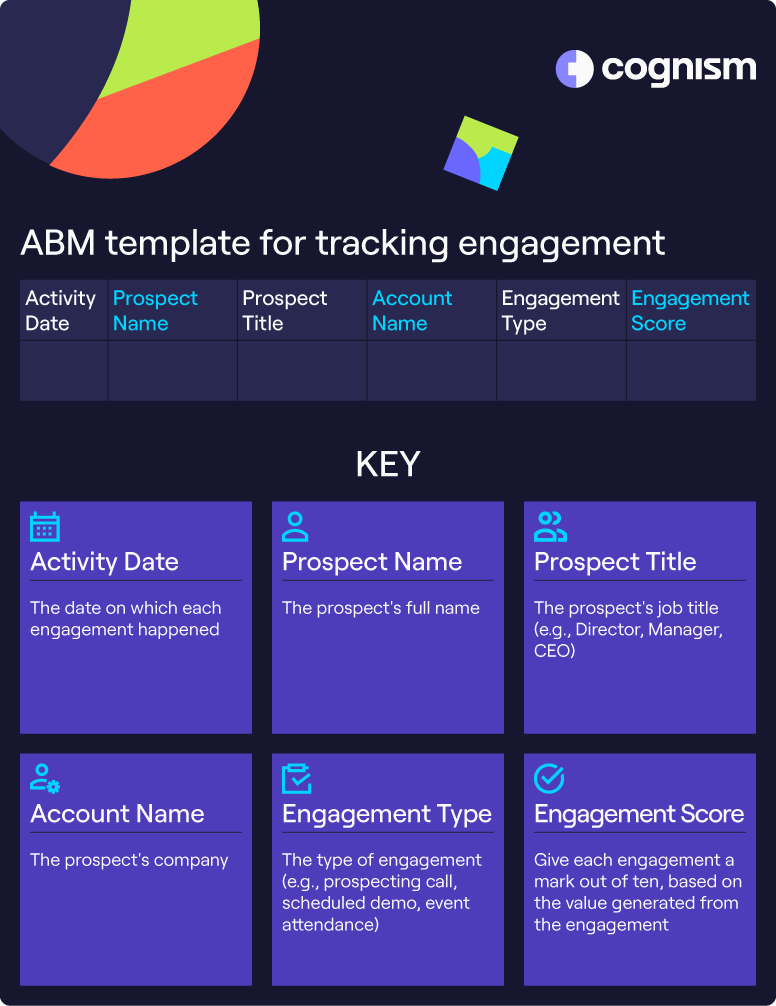
Use an ABM campaign tracking template to log engagement day by day. It doesn’t need to be complicated; a well-structured spreadsheet works:
Build your ABM campaigns with Cognism
You’ve got the framework. Now you need the data to make it work.
Cognism gives you the building blocks for every stage of your ABM campaign:
- For list building - access GDPR-compliant B2B data to identify and segment your target accounts. Filter by industry, company size, region, tech stack, and more.
- For intent signals - layer Bombora-powered intent data onto your ICP to find accounts that are actively researching topics related to your product. Stop guessing who’s in-market.
- For outreach - get verified emails and phone-verified mobile numbers that actually connect. Better deliverability, higher connect rates, and less time wasted on bad data.
- For your whole ABM motion - Cognism’s scaled ABM programme hit $700K in pipeline without a six-figure software bill. Good data and a clear plan beat a fancy tech stack every time.
Want to see how it works? Check out our full demand generation framework, or book a demo to see how Cognism’s data can power your next ABM campaign.
/CTAs%20(SEO)/cognism-dg-playbook-cta-webp.webp?width=750&height=265&name=cognism-dg-playbook-cta-webp.webp)